So, I figured I have some catching up to do. I went back and scrounged up 44 reviews (some very detailed; some only a sentence long). They go in descending order (from recent to oldest). Here we go:
Gimme Shelter - Documentary that chronicles a deadly Rolling Stones concert. I was very impressed with this. It perfectly captures the descent of a crowd's decency, and I think the crowd (not the Stones) are the real star. If "Woodstock" was about peace and psychedelia, then "Gimme Shelter" is about chaos and barbarism. Near the end, you see a girl in the front row in tears fighting her emotions to try and enjoy the Stones performing right in front of her. That encapsulates the tone of the doc perfectly. I didn't expect to like this as much as I did. I love the format of how the Stones reacting to the footage in retrospect carries the narrative of what actually happened. If there's one thing missing from documentaries, it would be any cinematic flair such as this. Consequently, if you bring a gun to a concert and are hopped up on meth, don't be so surprised if you leave in a body bag. That's just stupid if you ask me.
The Atoimic Brain (MST3k) - One of the few movies they've done where I had fun with the movie just for itself and wouldn't mind seeing again sans commentary. I love that the girls' accents are deplorable ("Dick Van Dyke had a better accent!"). It's all too obvious that they were hired for their looks and not their talents. Anyway, hilarious as always and quite fun if just a little dry in places.
The Hurt Locker - Story of the life of a bomb defuser in Iraq. Touted as the greatest Iraq movie yet (What was the reigning champ? Yeah, I dunno either). The problem with all the other ones is that they take the Iraq war's politics to task. This was just a well-done war story that takes place in Iraq (and couldn't be told anywhere else due to the job position). The director Kathryn Bigelow pulls out some stunning performances out of her unknown actors and creates compelling, nail-biting (albeit straight-forward and realistic) action sequences. The movie doesn't have a conventional plot, but the ticking clock of just making it to the end of the tour of duty alive is enough... esp when your bomb defuser is something of a wild card with an affinity to adrenaline rushes. "War is a drug" the opening quote proclaims, and this story makes great commentary for that. The advantages, the downside, the consequences. One element that I loved here that's missing in other Iraq movies: The soldiers react on instinct and are rewarded for their suspicions. Before, it's always "taken by surprise", so it's really nice to see U.S. soldiers' fears of insurgents confirmed instead of them always killing an innocent or dying (yes, yes, we get that... war is evil... blah blah blah). I think I found this to be darker with a better statement about war than just "war sucks". And it's not afraid to be humorous at times either. Audiences need that relief, otherwise they will become numb with tension, so that's a real testament to the power of this movie imo. Highly recommended!
The Goods - Jeremy Piven's a hired gun to sell cars for a failing business. Second time seeing it. Funny enough. Laughed harder during certain parts cuz I was anticipating them. Other parts I laughed really hard at before weren't as funny. Still fun.
Ghost - Directed by Jerry "Airplane!" Zucker, this movie is waaay better than it's supposed to be. Even with its flaws, it still comes off so endearingly. RIP Swayze. Cry
Anvil: The Story of Anvil - Watched under the pretenses of "The Real Life Spinal Tap". It's fascinating but not as charming as I'd hoped it to be. Definitely full of kooky people which makes it fun, but the struggle the band goes through was painful to watch sometimes.
Beyond the Mat - I don't know nor care much about pro wrestling. Now before you hit me with that folding chair, I'll say that this doc was very competent, informant and insightful. I was hoping for The Wrestler: The True Story. But Aronofsky's pic was like the focused narrative whereas this was more like A Survey of All the Behind the Scenes Stuff. Very nice that it covered pretty much every route a wrestler can go... but it sacrifices any focused narrative to accomplish that (excluding the vignette approach of individual performers). One major issue I had though. The documentarian violates the cardinal rule (don't interfere with your subject) by showing Mankind the horrified reaction of his wife and kids while at a show. "I feel like a bad father," Mankind says. Did he quit soon after that? He shouldn't have. The lesson should've been don't take your friggin wife & kids to the show!! The kids are def too young to understand what's going on. Don't quit. Just don't show them their dad getting beat the living snot out of him! Geez.
Starman - I was looking for something like "Ghost" and felt this might be similar (and in theme, it's exactly the same). Jeff Bridges is an alien recreated in the image of his widowed wife, Karen Allen and must get to Arizona in 3 days. Man, John Carpenter has got to be one of the most liberal users of B-roll footage of any working director. It reminds me of Ed Wood sometimes. The difference of course being Carpenter uses his for atmosphere and pacing whereas Wood used his as filler. Still... that's a LOT of b-roll footage! A good, notable sci-fi flick. I would watch it again if a friend really, really wanted to... but prob not of my own volition. BIG issue with the ending though.
Loose Change - Was 9/11 an inside job? This propag--documentary says yes. Watched this (again) because SModcaster Kevin Smith makes a good point: "Yeah, I know it's not real, but man, it's compelling." "JFK" is in my Top 3 movies of all time, so yeah, I'm gonna like this. I was mad and intrigued by the end, but a quick "Anti Loose Change" google search put things to rest. It's like a horror movie where the relief doesn't come until after you've left the theater and at home chillin on the computer.
I tried watching Farenheit 911 for the same thrill. Three of my fave docs of all time are "Bowling For Columbine", "Roger & Me" and "Fog of War". This might be my least favorite of Michael Moore's docs. Even as I watched it in theaters, I felt it was far too biased. He does not let up on Bush for anything. Compared to this, "Loose Change" comes off as even-handed and open-minded (a reason why I love "Bowling For Columbine"). I had to stop watching a half-hour in. It forsakes insight/discussion for finger-wagging. The best/worst part is that Obama could get blame for similar (albeit for the lesser things) but you know Moore wouldn't utter a peep about it. This doc is the bizarro Fox News equivalent. The liberal rioting during the presidential cavalcade in the beginning looks exactly like the conservative rioting seen of late. We're through the looking glass here, people.
Matrix: Revolutions (+RiffTrax) - Hilarious. Horrible movie. It's a Matrix RiffTrax. Of course, it's great. Also, I'm not convinced that there isn't a subtle nod to our Lost In Space iRiff at the 1:04:00 mark ("Quit shovin', Bob").
Puppet Master - Low budget, solid B movie. Fun enough. Puppets are best as supporting characters
Puppet Master II - Total waste of time. Not bad enough to be a fun bad movie. Uninteresting... which is like the biggest insult for a movie.
The Castle - Quirky, lovable little Aussie film that should get the recognition that only few great indie films get. I can't see anyone not liking this (Imrahil excluded).
Borat - Surprisingly still as hilarious as the first time I saw it (despite the incessant catch-phrase spewing it spawned), although I notice more and more staged moments the more I see it.
Lion King 1 1/2 - It's a Disney Direct-To-Video movie. Whaddaya expect? Most surprising thing was how well it was animated. Even if it's not a great movie, the animation is remarkably fluid, very character driven and sometimes even (dare I say?) beautiful.
The Goods - I chuckled at parts. I don't know if it was worth my $9... except that I laughed harder than I ever have at a movie ever before during one specific part. The beauty of it was that I knew very, very little about the movie going in. Unfortunately, if you ask anybody who saw it, they'll bring the scene up thereby ruining it for you. I was literally falling out of my seat and almost hit the floor and didn't stop till I got home (all this with only 6 people in the theater). Oh... and I absolutely doubt YouTubing would help. In fact, I would doubt I'd laugh at all with the scene completely isolated (and expected).
The Wrestler - Hadn't seen it since it was in theaters. Didn't think I'd revisit it ever again. But I had to revisit it just to bask in Mickey Rourke's performance. The desire to see it again spurned from my newly found favorite podcast Creative Screenwriter. That podcast should be included on every dvd as a separate audio track.
Meet the Spartans - This is about two universes collapsing on themselves. One is the movie "300", complete with plot and characters, wherein the other has all of 2007's cultural references invading. Will you survive watching this? I was sitting in Starbucks, checking out RedBox.com, and said outloud to myself, "Am I in the mood to watch this!?" I watched the trailer for it on YouTube. Sure enough, it seemed to hit some sick part of me. Maybe it was watching "Plan 9" that made me seek out another trainwreck. I certainly found it. I had heard how infamously Britney Spears just comes out of nowhere. But I got it (sort of). I mean, the setup is Leonides is asked to stop kicking people into a pit, but people who you want to see kicked into a pit keep showing up. It may not be funny, but that's at least a joke. But there were "jokes" that I had to rewind the movie for because I thought I missed something. Nope. Incoherency at its finest. Like when the queen dons the venom costume and the villain dude turns into sand. Why? Because it was in Spider-Man 3. That's it. NO FRIGGIN REASON other than that. As best as I can tell, this was written by two frat-dudes who wrote a screenplay one night after watching "Airplane!" That's not an exaggeration. That's exactly how it plays out. It isn't even long enough to be a movie. It's about an hour long, then the credits roll, then 10mins of deleted scenes, then 5 more mins of credits roll. That's when I realized that this movie hitting #1 at the box office was the moment the human race jumped the shark.
The Descent - I'd heard it was the best horror movie in 20 years. Indeed. It applies the "Jaws" method of playing your villain distant till the end of the movie. I got an hour into this movie and thought maybe I had the whole advertising wrong (of which I've seen slim to none). Maybe it was just a creepy "Vertical Limit" meets "The Poseidon Adventure"... with spelunking... or maybe it's just friggin brilliant. I seriously have not been scared by a movie like this for a long, long, long time. It affected me the whole day and I am still more hesitant before entering a dark room. I highly, highly recommend it.
Battle Royale - Japanese movie that takes place in a world where every year a class of students are stranded on a deserted island with weapons and all hafta kill each other within 3 days. I watched this right after "The Descent" to calm me down; sorta like a reminder that death can be Tarantino-style fun. I think I like it the more I watch it just because I forget that as great as it is, it certainly is not without its flaws, and I can remember more that it's fun and flawed.
Burn After Reading - "Hey, movie! You forgot your climax." I had heard that the Coen brothers write by writing themselves into a corner and then writing themselves out. When the movie ends, it totally feels like that. Now, for Coen-defenders, I "get" that last 5 minutes. It's just when I think about the complexity of what they're offering, I can't help but feel it could've been told better or perhaps at a more fun angle. Which brings me to the tone of the movie. It confused me tonally. Like it didn't know whether to be an action movie, a conspiracy movie, a kooky comedy, or what-have-you. I think it's trying to be all these things at once, but it sacrifices its cohesiveness to do that. I liked the story, and you can't not love Brad Pitt as the workout doofus, but I just wished it went somewhere. And maybe that's what this is supposed to be: "Why does every movie have to be 'about something'. Why can't movies be about 'ordinary life'?" But to say it's an ordinary story would be completely wrong. Crap... I wish I had an ending to this review.
Finished "Forgetting Sarah Marshall" (this has super-high re-watchability for me). Ran outta good comedies (i.e. mostly anything Apatow related) and wound up watching...
"Yes, Man" - Uggggh. I love "Liar, Liar", but this just came out so mediocre. I guess it's cuz LL never takes itself too seriously and doesn't care that there's barely a plot; it's simply a chance for Jim Carrey to do his thing. YM however tried to put pathos into a really flat character with really flat scenarios. The greatest joys I got was finding out Zooey Deschanel played the love interest and the Flight of the Conchords' manager plays Carrey's boss. Probably works best as a date movie... when there's nothing else to rent.
"Valkyrie" - Not great, but not at all bad. Just... very dry. It comes off more like something belonging on The History Channel than HBO. Tom Cruise is adequate, and anyone who disagrees cannot separate gossip from craft. Things really took off after the assassination attempt. If the movie started with the attempt and went from there, I think it would've been a great movie. And maybe if the characters were better fleshed out and accessible too.
"Slumdog Millionaire" - Haven't seen it since it came out in theaters. This joins the ranks of "Little Miss Sunshine" and "The Princess Bride". I don't know anyone who doesn't like it, and I don't know anyone I can't recommend it to who won't thoroughly love it as well (although SM might be at a disadvantage with being overhyped for some). It's just as heartbreaking as it is uplifting, and always, always entertaining. I loved it just as much the 2nd time as I did the first (maybe even moreso). Best soundtrack of the year too imho.
"I Love You, Man" - This should be a high-falutin', balls-out comedy with wacky characters with even wackier scenarios. But the writer/director knows that we get that with every comedy in the past 30 years. And every time it always gets in the realms of "Can you believe what's happening!? WINK!" Instead, we get a very simple, stripped-down comedy who grounds itself in reality. The girlfriend is never shrewish. There's no antagonist. The antagonist is the fact that Paul Rudd's character needs a best man for his wedding. When your antagonist is the story itself, well... I just love that. I liked this more than "Role Models"... but I had RM really hyped up for me. Gonna hafta give RM another shot. (Btw, I really like RM... I just don't love it... but maybe one day).
Saw "Funny People". Things I knew about it going in: It's very long (Apatow heading in an "epic length" direction) and it's just as dramatic as it is funny. Those are things you should know. Having known that, I absolutely loved it. Btw, if you don't like Apatow's movies, don't go see it (and what's wrong with you? j/k). Anyway, it is by FAR my favorite movie of the year. I haven't seen "Up" yet. I imagine I'll like that more. But "Funny People" is just awesome. It goes to some dramatic places that I haven't seen a (good) comedy go in a long, long while. I liken Apatow to James L. Brooks, a god of comedic sensibilities because he understands the drama and heart as well. Man, the movie just works, yknow? Having said all that, be forewarned it appears that audiences are divided. If you are a fan of stand-up or the world of comedy in general, then this is an absolute must-see... so go see it... now.
"Frost/Nixon". Very good movie (I dunno about Best Pic nominee). It's the antithesis to any Oliver Stone movie. And Frank Langella's potrayal of Nixon is far and away my favorite (which is actually saying a lot imo).
Dr. Horrible's Sing-Along Blog. This is my kind of humor. Exactly this. I would call it perfect except the third act's tone shifts so hard that I got whiplash.
The Hangover: Hilarious. I've enjoyed Zach Galifnakis for years. I'm glad I can bring him up in conversation now. I plan on going to see it again piss drunk and at the ghetto theater on a Friday night (that way I won't be the only one yelling at the screen). I'm guessing it will be a much richer experience that way. Incidentally, my friend who I saw it with relayed to me of how during his screening before, a guy yelled out during the trailer for the upcoming horror movie The Orphan: "She just threw that bitch off that slide!" I need to go to the ghetto theater more often.
In honor of Leno's passing of the torch to Conan, I decided to watch "The Late Shift." A 1996 HBO movie about the behind-the-scenes network politics responsible for the changes in late-night talk-show hosts, after the retirement of Johnny Carson from the Tonight Show with Leno and Letterman vying for the top spot. What a cast! Recognize who's playing Letterman? That's Christopher Guest regular John Michael Higgins AS DAVID LETTERMAN!!! He really shows his range here by creating a great character with impeccable mannerisms and never being a cartoony impression (despite what that pic may imply). And there's some genuine pathos too. Bonus is that his dialogue is so spot-on, it might just have well been written by Letterman himself. Other Christopher Guest regulars: Ed Begley Jr. and Bob Balaban as NBC suits. The "Best In Show" curator Don Lake even has a micro-role as Paul Shaffer. Kathy Bates headlines as the Machiavellian manager who unflinchingly does Leno's dirty work. "Hair" alumni George Burger himself (Treat Williams) plays the charismatic talent genius, Michael Ovitz. And Rich Little does his best John McCain impression as the king of late night, Johnny Carson (seriously, it's freaky how much his looks/voice fit the part). And who plays Leno? A then unknown who went on to a great role, right? You betcha! The guy went on to play the 9th grade science teacher in "Lost," Leslie Artz. Yeah, he gained some weight. The movie is made even more poignant now seeing Letterman say how much he wants The Tonight Show and how much he was willing to give up for it. But you know there's no way he could take over now. I highly recommend reading this here about what Conan's takeover could mean for Letterman. It was a really fun and informational movie to me. I mean I love these true-Hollywood-stories so there's that (that "Three Stooges" one was actually very good too).
Saw "State of Play" (starring Russell Crowe and Ben Affleck in a journalism conspiracy) where Jason Bateman has a small, funny but pivotal role in it. Really great movie for the person who loved "Michael Clayton" (not as good, but close).
"I Love You, Man": I loved "40 Year Old Virgin." I loved "Knocked Up." Basically, I love anything Judd Apatow comes even remotely close to lately. Did he have in part in making "Superbad"? Anyway, if you loved these type of movies, then this is a def must-see. Excellent cast imo too. I look forward to seeing more of some of the ancillary characters in future movies. And it's also surprisingly more light-hearted than I expected it to be. I mean, conflict is never exploited for dramatic purposes (and there's plenty of opportunity for it). I can't remember the last movie I saw that took drama this lightly but still remained charming without being saccharine. A worthy addition to my dvd collection. Put it somewhere between "Role Models" and "Forgetting Sarah Marshall."
"Knowing": Someone spilled the beans on the ending for me. Way to go, Facebook status obliviousness. Anyway, some really poor acting and I have a lot of questions about the logical progression of characters and events (the crux for a movie like this). Two stars at best. The script actually reminded me a lot of a cross between "Unbreakable," "Signs" and "The Happening." On the plus side, it has a couple wicked cool dream sequences just about worth the price of admission and some really great special effects sequences... not including a plane crash. I have yet to see a believable plane crash in a disaster movie that doesn't look like SimAirplane.
Twilight - A teenage Zoe Deschanel lookalike learns the lesson of abstinence from diamond-studded vampire, teenage Brendan Fraser wannabe (who presumably took acting lessons from Hayden Christiansen). I watched this in preparation for the RiffTrax release. I was expecting the worst. And I hafta say... it's not horrible. Dare I say... watchable? There are actually believable characters. I haven't seen a chick flick with believeable characters since "Mean Girls." The movie is also competently directed. The director knows how to hold back faces mugging, gets "real performances" (mostly) and offers a bleak atmosphere (which contradicts every sunbaked chick flick I've ever seen). My standard qualification for a chick flick is the lead girl has to be an average looking girl whoa acts like an embarrassed klutz all the time in front of the too-good-for-her guy. I didn't get that here. Also, vampire Edward Cullen talks through his brooding brow. Is that "hot" now? Cuz that's hilarious. The whole scene in the forest where she learns the weird-but-hot(?) boy is a vampire was full of eye-rolling, but the majority of the movie was..... not bad. Hmmm. I was kinda hoping for horribleness.
Push - The movie came and went out of theaters, which I assumed it was somewhere between mediocre to unforgettable to maybe down-right bad. I dunno what happened 'cause I really enjoyed myself. It's exactly like the trailer... but for 2hrs (which is exactly what I wanted to watch). The plot is the same as "X-Men 2" but told in the style of "Chungking Express." It's a solid, fun universe where people are born with superpowers. One difference from X-Men though is that there are just a handful of different superpowers that people have (which you could argue would benefit the X-Universe). One power is The Force from Star Wars... and this is exactly how it shoulda been done in the Star Wars movies: kickin some serious butt! Also, the movie utilizes the chess-like strategies that the X-Men movies/comics do so well to try to stay ahead of the bad guys. This, to me, was the real thrill of the movie. The guns a-blazin' and kinetic camera-work was nice eye candy too. Two things I love that "Push" does that the X-Men movies didn't do as well was showing a very natural evolution of a team driven completely by the plot. Every person there is added to move one step ahead. The other thing is that this is a ragtag buncha people trying to overthrow the evil agency. So the underdogs struggle with their powers as they try to defeat the experienced bad guys. This makes every defeat a major victory. I love that formula.
Lost In Translation - I will reiterate (by paraphrase) what David Letterman once said. Why don't they stop making bad movies and just make movies like this, say, once a month? I thought that while watching this again. Bill Murray's performance is more nuanced than I remember it too. Def worthy of the Oscar nom, if not the win. Touching, hilarious and bittersweet... after seeing it so many times even. Why can't Scarlett Johansson go back to being the indie-fim girl? She looks so much more beautiful when she's not all glammed up.
Coraline - This is one of the most imaginative movies I've seen in years. Seriously. It's part of the girl-gets-lost-in-dangerous-imagination-land genre (Alice In Wonderland, Pan's Labyrinth, MirrorMask, etc.). I'm glad I saw it in 2D cuz during the parts where my focus started to drift, I could always admire how amazing the animation was. Definitely reaches above and beyond the previous limitations of claymated movies. Very glad I saw it on the big screen. I bet a little something will be lost in the transition to the small screen. Haven't read the book but I heard it was nothing like it by one person (I think she meant the plot).
Watched "Defiance." Very good but nothing to write home about. Kinda weird seeing "Wolverine" a couple weeks before. Liev Schriber playing a violent ruffian intent on constantly fighting his brother in the same month? Okay.
Doubt - Second time seeing this. First time, I really did not like it. It was hyped as one of the best movies of the year, and I was severely disappointed. I still think it has some really clunky moments, but now that I can just ignore those out of foreknowledge, I was able to enjoy the parts where it really hit its stride (those moments are amaaazing). I think all the faults of the movie rely on a first-time director (aka Mr. I-Wrote-The-Script-AND-The-Play!!!). Sure, buddy. Maybe you should stick to that. Four stellar performances, but you know who the real star is? The chubby kid who gets in trouble. That kid is the best. If you've seen the movie, I think you'll agree with me here.
I watched Freddy's Dead: The Final Nightmare (aka Nightmare On Elm Street 6). This is my personal favorite NOES (although the first is by far the best). It's the least serious, yet (imo) never goes campy-beyond-comprehension; tongue is always planted firmly in cheek but retains a modicum of respect. It's also very '90s. The movie opens with a GooGoo Dolls song. The special effects are very of its time but still work. It also has cameos from Roseanne and Tom Arnold. And one of the kids looks like Jay (of Jay & Silent Bob [he later went on to play Jon Arbuckle in the "Garfield" movies.... weird]). I love when Freddy kills one of the kids with the Power Glove. It's so bad. I also really like the cool 3D scene (even in 2D). Look for Johnny Depp's cameo too (his first movie was the first NOES; his credit even gets an "Introducing" credit). I give it 4 Power Gloves out of five (sorry, I've been watching a ton of AVGN vids lately too).
Watchmen - I liked the faithful adaption-ness. I abhorred the pop music (enough to where I look forward to making my own fan-edit). I hated the giggles in the theater every time Dr. Manhattan was, er, in full display. I almost puked on the teen in front of me who wouldn't stop texting. I hated that my "graphic novel impaired" friends were mortally perplexed by everything. Rorshach, Nite Owl and Comedian were spot-on awesomeness. Still processing how much the rewritten climax changes every (or most) things the book was saying. And if you're gonna do that, then why include Ozymandias' pet? Perhaps that's for another thread.
"Appaloosa" - I'm reading John Badham's unashamed-to-drop-names (like Gary Busey!) book about how best to direct right now, so I couldn't help notice how poorly the movie was directed. The movie was fun enough, I suppose. Reminds me of a b&w western from the 50s that you'd catch on TCM on a Saturday afternoon. Ed Harris (who directed and co-wrote) was somewhat bland but interesting enough. I couldn't tell whether Jeremy Irons was trying to hide his accent or not. The best part was watching Viggo Mortensen slip into his role so nicely. A friend of mine didn't realize it was him until after the movie was over. There's a total riff-worthy moment near the beginning with the Chinese waiter. I can't remember the last time I saw acting that bad before in a recent movie. If 3:10 To Yuma is an 8 out of 10, "Appaloosa" would be a 6 at best. My running gag that I whispered to my friend: "There better be apples in this movie or else I'm going to be VERY disappointed." So when one character asks "Why you goin' back [to Appaloosa]?" I quipped "Probably because of the apples." It was pretty funny.
Slumdog Millionaire. The best way to describe it: "City of God: The Love Story." I think I might've hated the story mainly because I hate obvious coincidences (the movie hinges on the theme of coincidence anyway, so I'm aware how that's an invalid point). However, Danny Boyle is the total god and savior of this film. It alternates from jumpy, frenetic and visually entertaining flashbacks (think "Trainspotting" and "28 Days Later") to a more static yet very glowing and powerful stillness of the present day (think "Sunshine"). It's just as achingly heartbreaking as it is uplifting. While it may not be my favorite of the year, I'm tempted to put it in my Top 5. Then again, my fondness to "City of God" may be pushing it forward ever so slightly. A hearty recommendation. A sporting chance at a Best Pic Oscar nom in that underdog-indie-with-a-heart-of-gold-"Little Miss Sunshine"-"Juno" sorta way. You could probably take your grandparents to see it too. I saw it with a buncha old people and I never felt embarrassed or think they'd be lost by it because it's such the real crowd-pleaser.
Wednesday, October 7, 2009

Wednesday, June 24, 2009
Billy Mays Spills Water on Conan's Desk And Makes World Map
Usually I do movie reviews, but I have to share something I noticed last night. Pitchman celebrity Billy Mays was a guest on Tuesday night's episode of "The Tonight Show." Conan O'Brien brings out the (stolen by Shamwow) Zorbeez. To demonstrate its use, Billy Mays spills a mug of water onto Conan's desk. What no one realized was that Billy Mayes is also a topographical genius and can make a map of the world just by spilling water:

If only he had more water, he could've added Africa, Australia, Antarctica and the rest of the North American continent. Alas, multiplying water is not one of Billy Mays' superpowers.
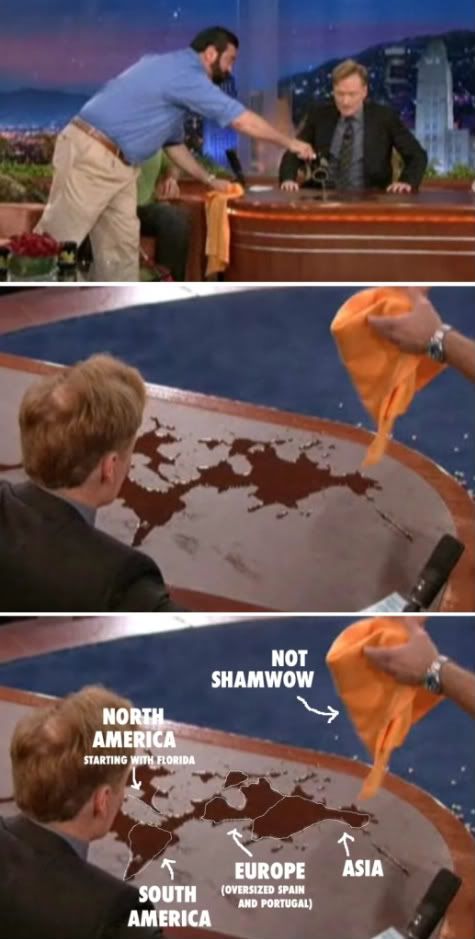
If only he had more water, he could've added Africa, Australia, Antarctica and the rest of the North American continent. Alas, multiplying water is not one of Billy Mays' superpowers.
Tuesday, March 24, 2009
My reaction to Yahoo!'s 100 Movies To See Before You Die
[Scroll to the bottom for the complete list]
I must say that I am in absolute shock. This is an extraordinary list. Even more impressive is that, unlike AFI's Top 100, this list includes foreign releases as well. And from Yahoo!? Really? They're not supposed to recommend "M" or "The Third Man." But rightly so, they do. Omissions were very, very difficult to think of (which is a sign of a great list). Most of the foreign ones I have not seen (sadly), but the ones listed (like "The 400 Blows" and "Wild Strawberries") I am very familiar with as being recognized so highly. I also commend its bold inclusion of movies like "Enter the Dragon" and "Fast Times At Ridgemont High." These are genre defining movies which should be welcomed just as any great director should be welcomed.
Every decade is represented rather well too. The past couple decades are not, and, if I may say so, should not be represented heavily. It commonly takes decades to discover whether a film can stand the test of time. The fewer, the better, I say. But sometimes you just have to include them (like "Lord of the Rings").
The only titles I take issue with are "The Usual Suspects," "Crouching Tiger, Hidden Dragon," "When Harry Met Sally...," and maybe "Titanic." Admittedly, these are great movies I would not only recommend to anybody but also wouldn't mind owning (if I don't already).
My favorite part of this list is how every omitted movie I try to think of is either on the list (yay "Groundhog Day"!) or has that director's seminal film present. For instance, "North By Northwest" didn't make the list, but Hitchcock's "Psycho," "Rear Window" and "Vertigo" all made it. Its exclusion deemphasizes Hitchcock, so that exclusion I understand. All the greats are represented well: Kubrick, Kurosawa, Truffaut, Fellini, Pinter and Bergman (most with multiple entries). Amazingly, those that I just mentioned happen to be considered by many the best directors of their respective countries: America, Japan, France, Italy, India and Sweden. China and Korea are also represented with their greatest filmmakers, Ang Lee and Wong Kar-Wai.
The only titles I truly think are omitted are "Forrest Gump," "The Princess Bride" and either of David Fincher's movies "Fight Club" or "Se7en." "Lost In Translation" is debatable, but the inclusion of Wong Kar-Wai's "In the Mood For Love" (the direct inspiration) is an inspired decision, because it not only draws allusion to Sofia Coppola's film but also puts Wong Kar-Wai on the list (which he most deservedly so belongs). I would also like to see Wes Anderson represented, but as I think about his films, I couldn't recommend them to anybody the way I could with everything else here. But if he were to be represented, either "Rushmore" or "The Royal Tenenbaums" would be on there. I would also like to have seen the Coen brothers on the list. But, as the problem with Wes Anderson, they may be a bit too quirky. If they were represented, I would say "Blood Simple," "Fargo," "The Big Lebowski" or "No Country For Old Men" should be listed.
I don't know how, but Yahoo! came up with a very inspired list; one that could easily rival AFI's Top 100. Dare I even say... better? Are there any movies you think were omitted? Here's the full list:
12 Angry Men (1957)
2001: A Space Odyssey (1968)
The 400 Blows (1959)
8 ½ (1963)
A Hard Day’s Night (1964)
The African Queen (1952)
Alien (1979)
All About Eve (1950)
Annie Hall (1977)
Apocalypse Now (1979)
The Battle of Algiers (1967)
The Bicycle Thief (1948)
Blade Runner (1982)
Blazing Saddles (1974)
Blow Up (1966)
Blue Velvet (1986)
Bonnie and Clyde (1967)
Breathless (1960)
The Bridge on the River Kwai (1957)
Bringing Up Baby (1938)
Butch Cassidy and the Sundance Kid (1969)
Casablanca (1942)
Chinatown (1974)
Citizen Kane (1941)
Crouching Tiger, Hidden Dragon (2000)
Die Hard (1988)
Do the Right Thing (1989)
Double Indemnity (1944)
Dr. Strangelove or: How I Learned to Stop Worrying and Love the Bomb (1964)
Duck Soup (1933)
E.T. the Extra-Terrestrial (1982)
Enter the Dragon (1973)
The Exorcist (1973)
Fast Times At Ridgemont High (1982)
The French Connection (1971)
The Godfather (1972)
The Godfather, Part II (1974)
Goldfinger (1964)
The Good, the Bad, and the Ugly (1968)
Goodfellas (1990)
The Graduate (1967)
Grand Illusion (1938)
Groundhog Day (1993)
In the Mood For Love (2001)
It Happened One Night (1934)
It’s a Wonderful Life (1946)
Jaws (1975)
King Kong (1933)
The Lady Eve (1941)
Lawrence of Arabia (1962)
The Lord of the Rings (2001,2002,2003)
M (1931)
M*A*S*H (1970)
The Maltese Falcon (1941)
The Matrix (1999)
Modern Times (1936)
Monty Python and the Holy Grail (1975)
National Lampoon’s Animal House (1978)
Network (1976)
Nosferatu (1922)
On the Waterfront (1954)
One Flew Over the Cuckoo’s Nest (1975)
Paths of Glory (1958)
Princess Mononoke (1999)
Psycho (1960)
Pulp Fiction (1994)
Raging Bull (1980)
Raiders of the Lost Ark (1981)
Raise the Red Lantern (1992)
Rashomon (1951)
Rear Window (1954)
Rebel Without a Cause (1955)
Rocky (1976)
Roman Holiday (1953)
Saving Private Ryan (1998)
Schindler’s List (1993)
The Searchers (1956)
Seven Samurai (1954)
The Shawshank Redemption (1994)
The Silence of the Lambs (1991)
Singin’ in the Rain (1952)
Snow White and the Seven Dwarfs (1937)
Some Like It Hot (1959)
The Sound of Music (1965)
Star Wars (1977)
Sunset Blvd. (1950)
Terminator 2: Judgment Day (1991)
The Third Man (1949)
This is Spinal Tap (1984)
Titanic (1997)
To Kill a Mockingbird (1962)
Toy Story (1995)
The Usual Suspects (1995)
Vertigo (1958)
When Harry Met Sally… (1989)
Wild Strawberries (1957)
Wings of Desire (1988)
The Wizard of Oz (1939)
Women on the Verge of a Nervous Breakdown (1988)
The World of Apu (1959)
Monday, February 23, 2009
My Oscar Reaction... sorta
I can't tell you how much I don't want to review the Oscars right now. I started a new job today. I'm preparing to leave for NY for the weekend on Friday. I've been doing things and going places non-stop since Friday. The last thing I want to do is review a 4hr anything. However, I shall give my opinions on it soon. Before Friday is gonna be my goal... time permitting.
I'll give you my highlights, starting with this introduction:
I think many audiences were dreading the Oscars. I'm not sure why. I, however, have been looking forward to this, well, pretty much since a year before (but especially within the past several months). Y'see, I've been reading movie news covering the Oscars since the buzz began (it usually starts the beginning of fall, but summer has its share of buzz too [remember "Dark Knight" was beginning of summer]). So as it all culminates into this one evening, my fears and apprehensions have already subsided. My expectations, carefully honed and calculated, are fulfilled with gentle ease (yeah, I knew it'd be a big night for "Slumdog" about a month ago). So much *could* go wrong. I was thoroughly pleased with pretty much all of it. And, I must point out, more highlights than the past 3 broadcasts combined. You may whine, but you know I'm right:
Here are my own personal highlights:
Epic Actor Award Presentation. Impossible to beat. The only way it could be bigger is if every living Academy member did a retrospective on each nominee. Really, how could it get any better?
Hugh Jackman's "I'm Wolveriiiine" crescendo. Top 5 funniest moments. Others on that list...
Ben Stiller's uproarious Joaquin Phoenix send-up
The Pineapple Express reprise.
Best speech of the night: Best Animated Short Film. "Domo arigoato, Mr. Robot."
Most entertaining acceptance: Best Documentary ("Man On Wire"). I had been looking forward to this ever since I saw it. The speech has a beautiful metaphor with a simple magic trick by the mischievous Philipe followed by the balancing of the Oscar on his chin. A bold and exhilarating act performed with as much destiny as was shown in the movie.
Slumdog got a lot of recognition. Probably too much. But I'm okay with that. Yeah! Take away from Benjamin Button and (ugh) The Reader! Go Slumdog! Wait... save room for Wall*E... oh, well, nevermind.
I was happy with every single win except one: Best Actor, Sean Penn. Bill Murray gave his career-defining performance in "Lost In Translation." Sean Penn gave yet another Oscar-bait performance and won instead that year with "Mystic River" (albeit a remarkable performance). Mickey Rourke gave his career-defining performance this year (and won every award he'd been nominated for) but lost to.... Sean Penn.
Best Foreign Film: "Waltz With Bashir" was supposed to win. "The Departures" (one of the biggest "Never heard of it" noms in the category) pulls arguably the hugest upset of the evening.
I <3 Tina Fey & Steve Martin. If a movie doesn't happen with them soon, riots will break out soon. I encourage these types of riots. More Tina Fey, please. More!
Heath Ledger's win: Seeing the teary-eyed distraught faces on the usually glittering faces of celebrities was absolutely heart-breaking. The Ledger family's acceptance seemed rehearsed by comparison. Nevertheless, it was a very sombre and touching moment. The terminally unlucky Bill Maher's opening line for the following category was prescient: "Everyone's crying and now I go on."
There are probably more moments I should talk about, but I'll hold off till later in the week. Check again soon!
Monday, February 9, 2009
The History of Poop In the Movies
I will designate all my entries of this blog into one of three categories:
1. Movie Reviews
2. Interesting Articles About Movies
3. Movie Contemplations (personal reflections about the art of film)
Here's an article that fits snugly into Category 2. It's called The History of Poop In the Movies:
http://www.slashfilm.com/2009/02/09/geekbomb-number-two-with-a-bullet-poop-in-the-movies/
"He called the sh** poop!!!" --Billy Madison, "Billy Madison" (1995)
Coming Soon To A Weblog Near You: Another Movie Review
Having my worldview of movie criticism obliterated by the article in my last post, I have felt a need to reviewing movies again (not sure exactly when, but soon). Why? That is something that I am struggling with internally. I have been muddled in indecision this whole interim, but what I need to realize is this: I can wallow in indecision without action or I can wallow in indecision with aimless action. Since aimless action is better than no action at all, I shall press forward in hopes that my actions have some meaning, whatever that may be.
"I have to believe in a world outside my own mind.
I have to believe that my actions still have meaning.
Even if I can't remember them.
I have to believe that when my eyes are closed, the world's still here.
Do I believe the world's still here?
Is it still out there?
Yeah.
We all need memories to remind ourselves who we are.
I'm no different.
Now, where was I?"
--Leonard Shelby, last words of "Memento" (2001)
Saturday, May 17, 2008
Revoking My Movie Reviewing
This may very well be my last post on this website. The reason for this is because one well-written article has single-handedly reshaped my views on all of film criticism. It is because of the reasons brought forth that I feel inept to continue to review movies. That is, until I can fully absorb all that has been brought forth to my attention. Here is the article in its entirety. I hope you will be enlightened just as I have been:
WHAT WE DON’T TALK ABOUT WHEN WE TALK ABOUT MOVIES
Armond White takes aim at the critics who write with their thumbs.
(originally posted here: http://ftl.nypress.com/21/17/news&columns/feature3.cfm)
By Armond White
There’s more writing about movies these days than ever before. In print and online, it’s never been worse—especially on the Internet where film buffs emulating the Vachel Lindsay-Manny Farber tradition are no longer isolated nerds but an opinionated throng, united in their sarcasm and intense pretense at intellectualizing what is basically a hobby.
Although criticism is everywhere, and some online reviewers prove themselves honest and less beholden to the power elite than print critics, the problem is this: So many Internetters get to express their “expertise,” which essentially is either their contempt or idiocy about films, filmmakers or professional critics. The joke inherent in the Internet hordes (spiritedly represented by the new REELZ-TV program The Movie Mob) is that they chip away at the professionalism they envy, all the time diminishing cultural discourse—perhaps as irreversibly as professional critics have already diminished it themselves.
Recently, professional critics have felt a backlash from this Internet frenzy. Print publications restructuring to keep up with the web have dismissed or offered buyouts to noticeable numbers of employees, including critics. Trimming these fatted ranks is a result of basic disrespect for criticism as both a true journalistic profession and a necessary intellectual practice.
This backlash follows a perfect storm of anti-intellectual prejudice: Movies are considered fun that needn’t be taken seriously. Movies contain ideas better left unexamined. Movies generate capital in all directions.
The latter ethic was overwhelmingly embraced by media outlets during the Reagan era, exemplified by the sly shift from reporting on movies to featuring inside-industry coverage. Focusing on weekend box-office totals—now a post-Sabbath religious habit—first legitimized movie-talk for that era enthralled with tax shelters, bond-trading and pro-trust legislation (peaking with Reagan’s regressive repel of the landmark 1949 Paramount Decree, giving back monopolies to the studios). This sea change in media attitude was typified by the American launch of Premiere magazine (finally trimmed away two years ago), which perverted movie journalism from criticism to production news. It familiarized the production of movies, not like the trade publications Variety and Hollywood Report do for industry participants, but by simply jettisoning exegesis and replacing interest in content with production stills, personality profiles and a humor column that witheringly trivialized the critic’s pursuit.
This disrespect for thinking—where film criticism blurred with celebrity gossip—has resulted in today’s cultural calamity. Buyouts and dismissals are, of course, unfortunate personal setbacks; but the crisis of contemporary film criticism is that critics don’t discuss movies in ways that matter. Reviewers no longer bother connecting movies to political or moral ideas (that’s was what made James Agee’s review of The Human Comedy and Bosley Crowther’s review of Rocco and His Brothers memorable). Nowadays, reviewers almost never draw continuity between new films and movie history—except to get it wrong, as in the idiotic reviews that belittled Neil Jordan’s sensitive, imaginative The Brave One (a movie that brilliantly contrasts vengeful guilt to 9/11 aftershock) as merely a rip-off of the 1970s exploitation feature Death Wish.
If the current indifference to critical thought is a tragedy, it’s not just for the journalism profession betraying its promise of news and ideas but also for those bloggers. The love of movies that inspires their gigabytes of hyperbole has been traduced to nonsense language and non-thinking. It breeds a new pinhead version of fan-clubism.
••••••••••••
What we don’t talk about when we talk about movies these days reveals that we have not moved past the crippling social tendency that 1990s sociologists called Denial. The most powerful, politically and morally engaged recent films (The Darjeeling Limited, Private Fears in Public Places, World Trade Center, The Promise, Shortbus, Ask the Dust, Akeelah and the Bee, Bobby, Running Scared, Munich, War of the Worlds, Vera Drake) were all ignored by journalists whose jobs are to bring the (cultural) news to the public. Instead, only movies that are mendacious, pseudo-serious, sometimes immoral or socially retrograde and irresponsible (4 Months, 3 Weeks and 2 Days, Army of Shadows, United 93, Marie Antoinette, Zodiac, Last Days, There Will Be Blood, American Gangster, Gone Baby Gone, Letters From Iwo Jima, A History of Violence, Tarnation, Elephant) have received critics’ imprimatur.
That there isn’t a popular hit among any of these films proves how critics have failed to rouse the moviegoing public in any direction.
Critics customarily show their allegiance to Hollywood blockbusters, granting them inordinate attention in the entertainment pages, but that’s not the way to build an enlightened public or a healthy culture. You can’t praise the Pirates of the Caribbean movies or the Bourne movies and then expect benumbed thrill-riders to sit still for A Prairie Home Companion, Neil Young: Heart of Gold or Munich. The critical consensus toward denial forsakes what really inspires passion in moviegoers—those priceless moments when a movie addresses personal emotion (Dakota Fanning asking “Are we still alive?” in War of the Worlds) or informs some confounding social experience (Broken Sky’s young lovers alienated by soulless disco beats).
Jeff Nichols’ Shotgun Stories is a perfect example of what critics don’t talk about. Shotgun Stories should have rocked film culture. Ideally complementing the Coen brothers’ No Country for Old Men, it questions the temperamental and social sources for modern behavior. Nichols tells a Faulknerian, Snopes-like story of male fecklessness and the reality of frustration in the American working class. We are introduced to three Hayes brothers in Arkansas: Son (Michael Shannon), Boy (Douglas Ligon) and Kid (Barlow Jacobs) are totally rudderless—gambling, coaching basketball, womanizing—yet succumbing to the instinct for vengeance passed on to them by their bitter, resentful mother. This recognizable sense of family isolation (the flipside of The Darjeeling Limited) reveals a warped masculinity that goes to the heart of American experience. Shotgun Stories is set in a Red State community, but the truth of its ineffectual, slatternly men can be seen across the country, even in Blue State parochialism.
Its story of warring clans (sympathetic reprobates mirroring sympathetic churchgoers) confirms a concept of brotherhood that has wide-ranging application, but it is primarily, stunningly empathetic. Like last year’s family drama Black Irish (another good, modest film that critics lost), Shotgun Stories deals with fundamental experiences that media consensus ignores. When Son and his siblings crash the funeral for their father (who left them behind when he remarried to begin a second family), it starts a stupid, unstoppable feud. Things get nasty and then work out tragically: It’s the opposite of There Will Be Blood, where things begin tragically then work out nastily—a trajectory that slakes the dissatisfaction and lack of control that spooks our everyday lives. Yet Shotgun Stories dramatizes human compulsion.
P.T. Anderson creates aestheticized tension and a floridly melodramatic, false sense of history that’s easy for critics to endorse. Blood is meant to impress, while Shotgun Stories is meant to be felt. Director-writer Nichols shows a weird yet authentic sense of classical style. This doesn’t feel like a regional work, nor is it a movie-soaked movie like The Darjeeling Limited. It’s between the two. Nichols understands countrified living and American habit that may repel urban reviewers: But it allows him to jump off from Hatfields-McCoys legend into a non-condescending vision of how slackerdom really manifests itself. He counters the meretricious tendency of Richard Linklater, Gus Van Sant and Judd Apatow films whose celebrations of American sloth have blunted the sensibilities of critics trying to keep up with industry fads.
There’s hardly language or space in our class-based, Hollywood-pledged film journalism to deal with the way Shotgun Stories keeps its Faulknerian roots while branching out to a new sense of American behavior. (When Boy’s car radio blasts a Ronnie Montrose song, suddenly reminding him of Kid, it’s the kind of richly authentic moment we used to only get in documentaries like Joel DeMott’s Seventeen.) Nichols’ lyric sense of location—of men and women keeping their own balance as they walk, argue and clash—conveys a complicated spiritual agony. Being a non-hipster film meant that Shotgun Stories was off established critics’ radar screens. Even I, shamefacedly, only caught up after it had opened; but it’s been the most resonant American movie so far this year.
Son, Boy and Kid’s actions (you have to be in touch with your own American roots to feel the humor in those names; the only thing left out is Phil Morrison’s Junebug) point toward a common, unknowable future. Nichols uncannily combines hope and despair. On appearance, Shotgun Stories is a world away from the attention-grabbing topicality of critics’ faves There Will Be Blood, In the Valley of Elah, Redacted, Rendition and The Kingdom; it’s quiet, almost elliptical like George Washington (David Gordon Green is the producer). Yet this terse family epic may be the Iraq War movie we’ve waited for without being able to articulate exactly what we wanted. Nichols’ complex mix of native resentment and culturally bred fury also contains knotted-up affection and pride. Shotgun Stories is genuine. When it ends, it isn’t over. It’s something to talk about.
••••••••••••
To discuss movies as if they were irrelevant to individual experience—just bread-and-circus rabble-rousers—breeds indifference. And that’s only one of the two worst tendencies of contemporary criticism. The other is elitism.
This schism had an ironic origin—the popularization of film criticism as a consumer’s method. A generation of readers and filmgoers were once sparked by the discourse created by Pauline Kael and Andrew Sarris during the period that essayist Philip Lopate described as ìthe heroic era of moviegoing.î The desire to be a critic fulfilled the urge to respond to what was exciting in the culture. Movie commentary was a media rarity in those days and relatively principled (even the Times’ Arts & Leisure section used to present a forum for contrary opinions). And then the television series At the Movies happened. Its success, moving from public to commercial broadcast (who can tell the difference anymore?), resulted in an institution. Permit an insider’s story: It is said that At the Movies host Roger Ebert boasted to Kael about his new TV show, repeatedly asking whether she’d seen it. Kael reportedly answered “If I want a layman’s opinion on movies, I don’t have to watch TV.”
Kael’s cutting remark cuts to the root of criticism’s problem today. Ebert’s way of talking about movies as disconnected from social and moral issues, simply as entertainment, seemed to normalize film discourse—you didn’t have to strive toward it, any Average Joe American could do it. But criticism actually dumbed down. Ebert also made his method a road to celebrity—which destroyed any possibility for a heroic era of film criticism.
At the Movies helped criticism become a way to be famous in the age of TV and exploding media, a dilemma that writer George W. S. Trow distilled in his apercu “The Aesthetic of the Hit”: “To the person growing up in the power of demography, it was clear that history had to do not with the powerful actions of certain men but with the processes of choice and preference.” It was Ebert’s career choice and preference to reduce film discussion to the fumbling of thumbs, pointing out gaffes or withholding “spoilers”—as if a viewer needed only to like or dislike a movie, according to an arbitrary set of specious rules, trends and habits. Not thought. Not feeling. Not experience. Not education. Just reviewing movies the way boys argued about a baseball game.
Don’t misconstrue this as an attack on the still-convalescent Ebert. I wish him nothing but health. But I am trying to clarify where film criticism went bad. Despite Ebert’s recent celebration in both Time magazine and The New York Times as “a great critic,” neither encomium could credit him with a single critical idea, notable literary style or cultural contribution. Each paean resorted to personal, logrolling appreciations. A.O. Scott hit bottom when he corroborated Ebert’s advice, “When writing you should avoid cliché, but on television you should embrace it.” That kind of thinking made Scott’s TV appearances a zero.
Unfortunately, it is this very process of affirming the Ebert institution that contributes to confusion about what film criticism has lost. Time marvels that Ebert “typically would give thumbs up to two or three” of the “four or five films up for review on his weekly TV show” without asking if it’s credible or disingenuous. (It will take a separate article to expose the absurdity of a TV show bearing Ebert’s name without his presence, whose interchangeable roster of ineffectual reviewers loyally prevaricate in Ebert’s manner—a “criticism” show owned and sponsored by the Disney conglomerate!)
In the Ebert age of criticism, the Aesthetic of the Hit dominates everything. Behind those panicky articles about critics losing their jobs (what about autoworkers and schoolteachers?), lurks the writers’ own fear of falling victim to the same draconian industry rule: Most publishers and editors are only interested in supporting hits in order to reach Hollywood’s deep-pocket advertisers. This is what makes traditional criticism seem indefinable and obsolete, leaving web criticism as a ready (but dubious) alternative.
The Internetters who stepped in to fill print publications’ void seize a technological opportunity and then confuse it with “democratization”—almost fascistically turning discourse into babble. They don’t necessarily bother to learn or think—that’s the privilege of graffito-critique. Their proud non-professionalism presumes that other moviegoers want to—or need to—match opinions with other amateurs. That’s Kael’s “layman” retort made viral. The journalistic buzzword for this water-cooler discourse is “conversation” (as when The Times saluted Ebert’s return to newspaper writing as “a chance to pick up on an interrupted conversation”). But today’s criticism isn’t real conversation; on the Internet it’s too solipsistic and autodidactic to be called a heart-to-heart. (Viral criticism isn’t real; it’s mostly half-baked, overlong term-paper essays by fans who like to think they think.)
And in print, “conversation” is regrettably one-sided. Power-sided. This is where the elitist tendency sours everything. The social fragmentation that fed the 1980s indie movement, decentralizing film production away from Los Angeles, had its correlative in film journalism. Critics everywhere flailed about for a center, for authority, for knowledge; they championed all sorts of unworked-out, poorly made films (The Blair Witch Project, Gummo, Dogville, Southland Tales) proposing an indie-is-better/indie-is-new aesthetic. The sophomoric urge to oppose Hollywood fell into the clutches of Hollywood (i.e., Sundance). Similarly, the decentralized practice of criticism now scoffs at former New York Times potentate Bosley Crowther, while crowning a network of bizarro authorities—pompous critics who replace Crowther’s classical-humanist canon with a hipster/avant-garde pack mentality (from The Village Voice to Time Out New York to IndieWire).
The new inclination is to write esoteric criticism. Post-Tarantino cinema has wrung the pop aesthetic dry, so the new gods of criticism have made totems of movies so unwatchable and so unappealing that they prohibit the basic pleasure and amazement of moviegoing. Critical babble doesn’t talk about what matters, but it sustains Ten Current Film Culture Fallacies: 1)“The Three Amigos” Iñárritu, Cuarón and del Toro are Mexico’s greatest filmmakers while Julian Hernandez is ignored. 2) Gus Van Sant is the new Visconti when he’s really the new Fagin, a jailbait artful dodger. 3) Documentaries ought to be partisan rather than reportorial or observational. 4) Chicago, Moulin Rouge and Dreamgirls equal the great MGM musicals. 5) Paul Verhoeven’s social satire Showgirls was camp while Cronenberg’s campy melodramas are profound. 6) Brokeback Mountain was a breakthrough while all other gay-themed movies were ignored. 7) Todd Haynes’ academic dullness is anything but. 8) Dogma was a legitimate film movement. 9) Only non-pop Asian cinema from J-horror to Hou Hsiao Hsien counts, while Chen Kaige, Zhang Yimou and Stephen Chow are rejected. 10) Mumblecore matters.
These delusions derive from an elitist, art-for-art’s-sake notion. It’s the “Smart About Movies” syndrome allowing bloggers and critics to feel superior for having suffered through Dead Man, Ye-Ye, Gerry, Inland Empire—movies that ordinary moviegoers want no part of and that hardly reflect a community of citizens or the New Millennium’s political stress. It may be a coincidence of social class that most movies are made by people espousing a liberal bent, but it is the shame of middle-class and middlebrow conformity that critics follow each other when praising movies that disrespect religion, rail about the current administration or feed into a sense of nihilism that only people privileged with condos and professional tenure can afford.
Routine reporting from Cannes and Sundance is another expression of journalists’ perks that encourage a sense of elitism. Fact is, those fests are remote from how most people experience or relate to film culture. Like the weekend grosses list, it promotes a false sense of being informed—not art interpretation or feeling. And festival favorites aren’t discussed in fundamental terms. Critics talk around what’s happening inside Pedro Costa or Apichatpong Weerasethakul movies. Instead, they call the latter “Joe”—proof of their in-group shamelessness. They’d rather make xenophobic jokes about Weerasethakul’s exotic name than actually deal with the facts of his Asianness, his sexual outlawry and his retreat into artistic and intellectual arrogance that evades social categorization. Such hipoisie canonizing is as unhelpful as TV’s pop reviewers who only respect banal Hollywood blockbusters. They also, consequently, discuss the Oscars as a plebiscite that readers must dutifully and mindlessly observe. It’s entertainment—weakly.
Avoiding the substance of movies in film discussion has worsened beyond Ebert’s TV glibness. Recall how few critics were able to apply standard Judeo-Christian readings to No Country for Old Men (let alone The Passion of the Christ) but remained perplexed or aggrieved. Contemporary criticism doesn’t deal with politics, morality or history. That’s why critics wrote head-in-the-sand responses to the obvious Clinton censure in David Mamet’s The Winslow Boy and praised socialist Mike Leigh’s Topsy-Turvy as if it were an Anglophile’s Merchant-Ivory pageant. They even let pass the Paranoid Park scene of a security guard’s vivisected torso crawling across railroad tracks—surely the most egregious movie moment of the decade. Critics say nothing about movies that open up complex meaning or richer enjoyment. That’s why they disdained the beauty of The Darjeeling Limited: Wes Anderson’s confrontation with selfishness, hurt and love were too powerful, too humbling. It’s no wonder that the audience for movies shrinks into home-viewership; they also shrink away from movies as a great popular art form.
These desperate stakes became even more alarming with the recent announcement of the Museum of the Moving Image’s Second Annual Institute on Criticism and Feature Writing—a project seemingly designed to further confuse the profession. Offering a session on marketing and publicity, the MMI’s Institute implies that flackery is part of critical journalism, and that’s really the root of the problem—sanctioning the way in which critical journalism has blurred its mandate into promoting the industry, not the art form. It overlooks any chance for criticism to unite while enlightening the audience, keeping it divided. There is no “conversation” when what we say when we talk about movies is driven by elitism or commerce, both now horribly combined in Queens. Hollywood’s emphasis on impersonal product then holds sway over art. Ideas get smothered in formula, and hype becomes the language of so-called discourse.
Does the training of movie critics matter if they aren’t taught to preserve the idea that movies must affirm our humanity? The public deserves critics who appreciate when an audience wants to be moved, encouraging them to experience catharsis at World Trade Center or War of the Worlds. But when people walk out of Paranoid Park feeling bewildered and unedified, where do they turn? What do they talk about?
Subscribe to:
Posts (Atom)